
As farmers across the Midwest gear up for the 2026 planting season, staying informed about crop insurance deadlines, policy enhancements, and support programs is more critical than ever. With unpredictable weather patterns, fluctuating commodity prices, and evolving federal regulations, having robust risk management in place can make all the difference in protecting your farm’s bottom line. At Lund & Smith Insurance Services, we’re dedicated to empowering producers like you with actionable insights drawn from our Spring 2026 newsletter. This comprehensive guide expands on key areas, providing deeper explanations, practical examples, and tips to help you optimize your coverage. Whether you’re a beginning farmer navigating your first few years or an experienced operator fine-tuning your strategy, these updates are designed to help you thrive amid uncertainties.
Current Reminders:
These foundational reminders serve as the backbone of your crop insurance preparation. Overlooking them can lead to missed opportunities, reduced coverage, or denied claims. Let’s dive deeper into each one to ensure you’re fully equipped:
- ARC/PLC Sign-Up Delay: The Agriculture Risk Coverage (ARC) and Price Loss Coverage (PLC) programs—key federal safety nets that provide payments when crop revenues or prices fall below guaranteed levels—have seen their sign-up period delayed indefinitely. ARC offers revenue-based protection, ideal for areas with yield variability, while PLC focuses on price drops and suits stable-yield regions. Without a announced timeline, monitor USDA announcements closely. In the meantime, review your past elections; for instance, if you chose ARC in 2025, consider how county-level triggers performed in your area to inform future decisions.
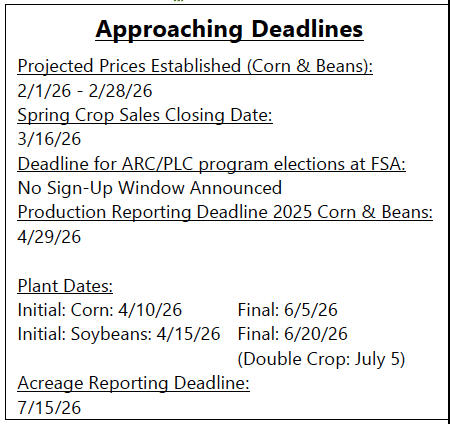
- Policy Changes Deadline: All modifications to your 2026 policy, such as updating your farm entity (e.g., from sole proprietorship to LLC), adjusting ownership percentages, revising share agreements among partners, incorporating new acreage from land purchases or leases, or altering coverage levels (like bumping from 75% to 85% revenue protection), must be finalized by March 16th (since March 15th is a Sunday).
- Submit 2025 Production Data: Forward your 2025 harvest yields and production records to us promptly if not already done. This data updates your APH database, which is the average yield history used to calculate your insurance guarantees and premiums. An accurate APH ensures quotes reflect your farm’s true productivity—e.g., if your 2025 corn yield was 200 bushels per acre, it could boost your 2026 guarantee.
- Planting Date Implications: Crops planted prior to the initial plant date (detailed below) are ineligible for replant payments unless you add the Replant Extra endorsement. This rule prevents coverage for speculative early planting risks. For late planting, coverage drops 1% daily post-final plant date: up to 20 days for corn (max 20% reduction), 25 days for soybeans (max 25%), and 10 days for double-crop soybeans (max 10%).
- Replant Notification Requirement: If replanting is needed due to poor stands, disease, or weather damage, contact us via call or text before any fieldwork begins! Pre-authorization is mandatory; without it, claims are denied outright.
USDA Earliest Planting Dates for Soybeans
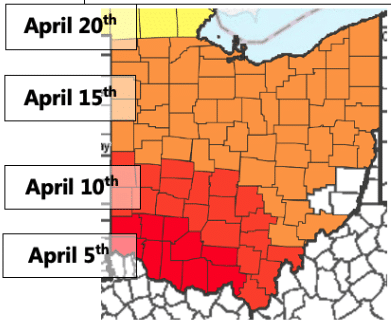
The RMA updated the earliest planting dates last year which affects all soybean growers in Ohio and Michigan. This much-needed improvement to the federal policy allows replant coverage on the MPCI policy to kick in earlier in the month of April. Soybeans planted in Northern Ohio on/after April 15th and Southeast Michigan on/after April 20th are now eligible for federal replant coverage. See updated Planting dates to the right.
Changes to Crop Insurance with the One Big Beautiful Bill Act
Enacted in July 2025, the One Big Beautiful Bill Act represents a landmark update to the federal farm bill, emphasizing affordability and accessibility in crop insurance. By boosting subsidies and flexibility, it aims to reduce barriers for all farmers, especially in high-risk areas like Ohio. Below, we expand on the four pivotal changes, including eligibility details and potential impacts:
- Expanded Beginning Farmer & Rancher (BFR) Benefits: Now extended to 10 years of farming experience (up from 5), this includes extra 10% premium subsidies and waived administrative fees. A “beginning farmer” is defined as someone with no more than 10 years as a primary operator. Impact: For a young Ohio corn grower, this could slash premiums by 15-20%, freeing capital for equipment or land. Eligibility requires documentation like tax returns showing farming income.
- Higher Overall Premium Subsidies: Federal contributions now cover a larger share (up to 67% on average) across coverage levels (50-85%) and unit structures (enterprise, optional, basic). This applies universally, lowering net costs—e.g., an 85% RP policy might drop from $20/acre to $15/acre. Why it matters: In volatile markets, higher subsidies encourage broader adoption, stabilizing farm incomes.
- Improved Add-On Coverage Support: Supplemental Coverage Option (SCO), Enhanced Coverage Option (ECO), and similar area-wide plans now enjoy up to 80% subsidies (previously lower). These layer on top of base policies for added protection. For instance, SCO covers 14% of deductibles at county levels, now more affordable for risk-averse farmers.
- More Flexibility with SCO: Previously tied to PLC enrollment, SCO can now pair with ARC or stand alone. This decoupling allows tailored strategies—e.g., combine ARC’s revenue focus with SCO’s yield protection for comprehensive hedging against both price and production risks.
Enhanced Coverage Option (ECO) – Top 4 Benefits
ECO builds on your RP policy with county-triggered indemnities, ideal for catastrophic events affecting wide areas. It’s not a standalone product but an endorsement, with triggers based on county data from the National Agricultural Statistics Service. Here’s a deeper look at its advantages:
- Even Higher Increased Subsidy: Jumping to 80% for 2026 (from 65%), this reduces your premium share to 20%. For a $10/acre gross premium, you’d pay just $2/acre—making it accessible for smaller operations in Defiance County.
- Higher Coverage Levels: Options include 86-90% or 86-95% bands on county expected revenue/yield. This fills the gap above standard 85% policies; e.g., if county revenue falls to 80% of expected, you’d receive indemnities for the shortfall.
- County-Level Coverage: Payments activate on aggregate county losses, not individual farms, providing a macro safety net. Useful in Ohio for widespread droughts—unlike MPCI’s farm-specific focus.
- Individual Production History Matters: Indemnities scale with your APH: higher yields mean bigger payouts. If your APH is 20% above county average, your payment could be proportionally larger, incentivizing efficient practices.
Replant Extra Policy – Top 4 Benefits and Cost
This supplemental endorsement addresses gaps in standard MPCI replant provisions, which often fall short of real costs. It’s particularly valuable in Ohio’s early-spring volatility. Expanded benefits include:
- Pays on the First Acre: No minimum thresholds—covers even small patches, unlike MPCI’s 20-acre/20% rule. Example: A 5-acre washout qualifies immediately.
- Extended Coverage Window: Starts 20 days before MPCI dates (soybeans March 26, corn March 21), enabling early planting with protection. This flexibility can capture better weather windows.
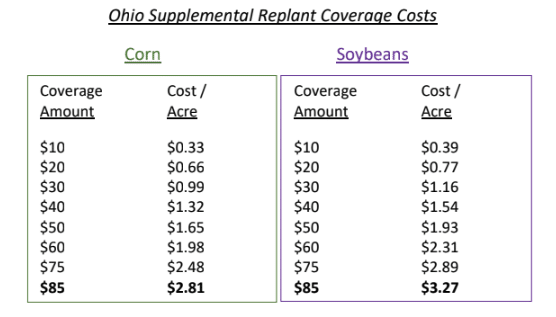
- Boosted Payouts: Adds up to $85/acre atop MPCI’s $30-45/acre, totaling $115-130/acre. Covers actual expenses like $50/acre seed and $40/acre labor.
- Accounts for Opportunity Costs: Beyond direct costs, delays reduce yields (e.g., 10-20 bushels/acre for corn). Replant Extra mitigates this by funding timely fixes.
Farmer Bridge Assistance Program Information
The FBA acts as a financial bridge post-2025, injecting cash flow for 2026 inputs. It’s a one-time payment, not a loan, based on FSA-reported 2025 acres—no new reporting needed.
Eligible producers receive pre-filled applications around February 23, 2026, with disbursements by February 28. Rates: $44.36/corn acre, $30.88/soybean acre, $39.35/wheat acre, plus others like oats or sorghum. For a 500-acre corn farm, that’s over $22,000—crucial for seed, fertilizer, or debt service. Ensure your 2025 reports are accurate; discrepancies could delay funds.
Prevent Plant Reminder:
When planting is impossible due to excess moisture or other insured perils, prevent plant coverage kicks in—but with strict rules. Eligibility requires the acre was farmed in at least one of the prior four years.
- Payments: 55% of guarantee for unplanted corn, 60% for soybeans. E.g., with a $800/acre corn guarantee, you’d get $440/acre.
- PF Option Removal: No +5% buy-up for 2026; standard levels only.
- Second Crop Option: Plant after final date, but payment drops to 35% ($280/acre in example), plus no insurance on the second crop and potential APH impacts.
- Cover Crops: Plant without penalty—e.g., rye or radishes improve soil while preserving full payment.
Navigating prevent plant? Consult us early to weigh options like switching crops or claiming.
If these details spark questions or you need a custom quote, reach out to Lund & Smith today. We’re here to support your success in 2026 and beyond.
Review Your Coverage Options?
Intersted in learning more about Crop Insurance or want to make a switch?